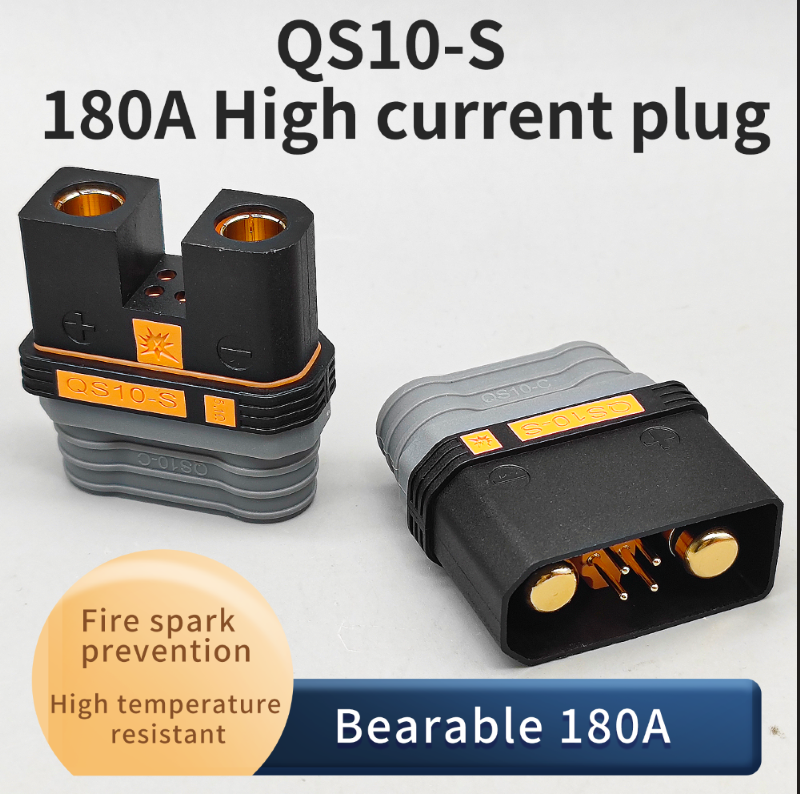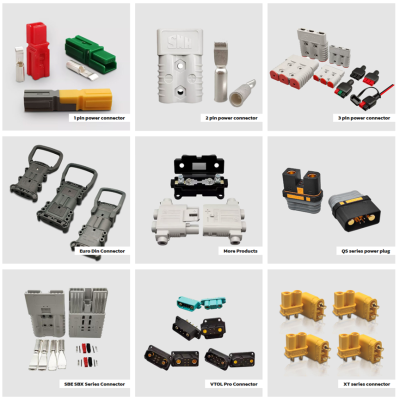
The QS10S connector is an anti‑spark battery connector designed to safely connect and disconnect high‑power lithium battery packs (LiPo/Li‑ion) used in e‑mobility, drones, robotics, and portable power systems. Its primary purpose is to eliminate the large inrush spark that occurs when high‑capacity batteries are connected to low‑impedance loads (controllers, ESCs, BMSs, capacitors), protecting connectors, devices, and operators.
Key Characteristics
- Anti‑spark function: built‑in pre‑contact or resistive precharge element that limits inrush current and prevents visible/arcing sparks at initial mating.
- Current rating: typically sized for high‑current applications (commonly 80–200 A continuous depending on variant and cable). Verify specific QS10S datasheet for exact rating.
- Voltage rating: suitable for common battery voltages used in e‑mobility and drone packs (e.g., up to ~60–100 V nominal depending on design).
- Gender and form factor: compact, robust housing with polarized mating to prevent reverse connection. Designed for inline or panel use depending on model.
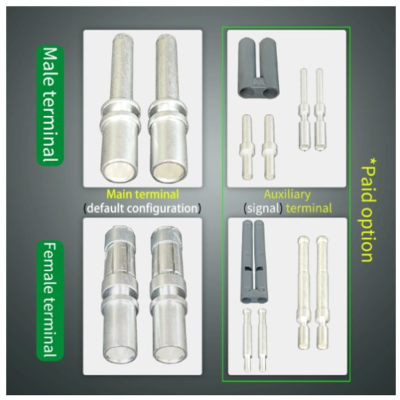
- Contacts: high‑conductivity copper alloy, often silver or nickel plated for low contact resistance and corrosion resistance.
- Mechanical: positive latch or lock to ensure secure connection under vibration; often lightweight for mobile platforms.
Typical Features & Benefits
- Prevents connector damage and pitting from repeated hot‑plugging of high‑energy systems.
- Protects downstream electronics (ESCs, converters, BMS) by avoiding capacitor charging spikes and potential component failure.
- Improves safety for operators by eliminating visible sparks and reducing fire risk during connection.
- Simplifies field operations and maintenance where frequent battery swapping or hot‑plugging occurs.
- Often compatible with standard high‑current housings and can be integrated into modular battery packs.
Common Applications
- Electric scooters, e‑bikes, and light electric vehicles (LEVs) for safe battery swaps.
- Multirotor drones and VTOLs where payloads or batteries are frequently connected/disconnected.
- Robotics and AGVs where batteries or modules are hot‑swapped in service.
- Portable power stations and UPS systems requiring safe connect/disconnect of battery modules.
- Test benches and production environments to protect equipment during repeated mating cycles.
Installation & Best Practices
- Match connector current and voltage ratings to system requirements; account for peak/inrush currents and duty cycles.
- Use correct cable gauge and high‑quality crimps or solder joints to minimize resistive heating.
- Ensure proper polarity and keyed mating; label and color‑code where multiple connectors exist.
- Verify mechanical retention (latch/lock) and provide strain relief to prevent mechanical stress on terminals.
- Test in a controlled environment after installation: measure contact resistance, check anti‑spark action, and confirm safe operation under load.
- Follow manufacturer instructions for torque, crimp tooling, and maintenance intervals.
Limitations & Considerations
- Anti‑spark devices add small size, weight, and cost compared with a plain connector—evaluate tradeoffs for lightweight systems.
- Some anti‑spark designs may introduce a small series resistance or heat during prolonged high loads; ensure thermal management and derating as recommended.
- Not a substitute for comprehensive battery safety systems (fuses, BMS, proper enclosure, and ventilation).
- Compatibility: ensure mechanical and electrical compatibility with existing connectors, enclosures, and battery management systems.
Conclusion
The QS10S anti‑spark battery connector is a practical safety and reliability enhancement for high‑power battery systems that require frequent or hot‑plug connections. By preventing high‑energy inrush sparks, it extends connector life, protects electronics, and improves operator safety—making it valuable for e‑mobility, drones, robotics, and portable power applications. For precise ratings, installation details, and certified uses, consult the QS10S manufacturer datasheet and application notes.